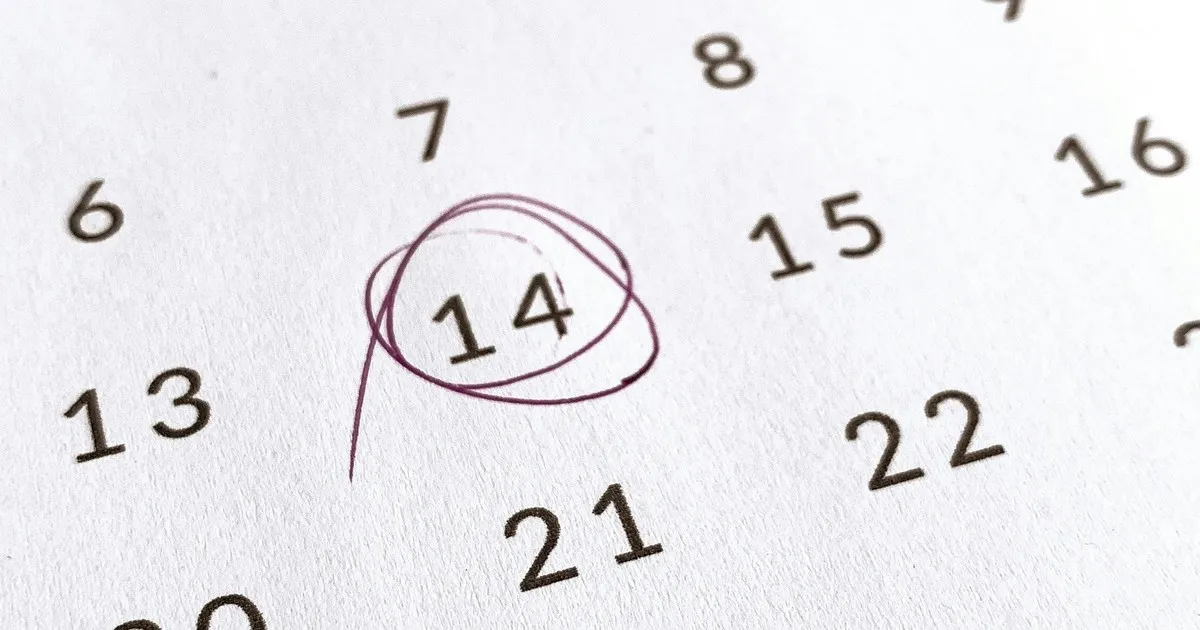
Cycle-linked bloating has a documented timing pattern, and it’s not quite the one most people assume. Research tracking daily symptoms found fluid retention actually peaks on the first day of your period, not the days before it. In perimenopause, increasingly irregular, often anovulatory cycles disrupt this pattern’s timing, which is part of why it can start to feel unpredictable.
You used to know almost to the day. Bloating would show up, you’d note it, and your period would follow within 48 hours, reliable enough that you half-used it as a calendar. Now it shows up early, or late, or not at all before a period that arrives anyway, or shows up and then your period doesn’t come for another two weeks. The pattern you used to trust isn’t behaving the way it used to, and that’s disorienting in a specific way that’s different from the bloating itself.
The timing almost everyone assumes is backwards
The common assumption is that bloating peaks premenstrually, in the days right before your period starts. A year-long study tracking 765 menstrual cycles across 62 healthy women, using daily symptom diaries and confirmed ovulation timing, found something different: self-reported fluid retention was actually lowest during the mid-follicular phase, then rose gradually across the days around ovulation, and peaked specifically on day one of menstrual flow, not before it.
That’s a real mismatch between lived expectation and measured pattern. It doesn’t mean premenstrual bloating isn’t real for a lot of women. It means the peak, on average across a large tracked dataset, lands right as your period starts rather than in the days leading up to it, which is a more precise and slightly different claim than the popular version.
The same data shows the rise starting earlier than most people assume too, not just in the final premenstrual days. Scores climbed gradually across the roughly eleven days surrounding ovulation itself, more than a week before the eventual day-one peak, before continuing upward through the back half of the cycle. That longer, gradual build is a messier and more accurate picture than a single sharp premenstrual spike.
The mechanism behind the pattern
Progesterone, which rises after ovulation and falls sharply right before your period, has real, multi-part effects on digestion. It relaxes smooth muscle throughout the gut, which slows transit. That specific mechanism is explained in more depth elsewhere on this site. It also affects how your body handles sodium and fluid, through pathways involving the renin-angiotensin-aldosterone system, contributing to the fluid retention layered on top of any gas-related bloating.
Both estrogen and progesterone contribute to increased plasma volume and subtle sodium retention in the days around and after ovulation, which lines up with the timing data above better than the premenstrual-only assumption does. None of this happens in isolation from the gas-related bloating covered elsewhere on this site either. Slower transit from progesterone’s effect on smooth muscle and fluid retention from its effect on sodium handling are two separate mechanisms running on the same hormonal clock, which is part of why cycle-linked bloating can feel like more than one kind of uncomfortable at once.
Why perimenopause scrambles the pattern specifically
In your reproductive years, ovulation happens on a fairly predictable schedule, which is exactly why the two-week bloating pattern felt reliable enough to set a watch by. Perimenopause disrupts that predictability at the source. Ovulation itself becomes erratic, cycles increasingly skip it entirely, called anovulatory cycles, and when that happens, the second-half progesterone rise that drives the classic pattern simply doesn’t happen that month, while estrogen keeps fluctuating on its own separate, increasingly erratic schedule.
The result isn’t that the mechanism stopped working. It’s that the mechanism now runs on a schedule that itself keeps changing, which reads, subjectively, as your body no longer being predictable, when what’s actually happening is a hormonal timing system generating a different pattern practically every month.
| What you’re noticing | What’s likely happening |
|---|---|
| Bloating still tracks fairly close to your period, most months | Ovulation is probably still happening most cycles |
| Bloating shows up with no period following for weeks | Possibly an anovulatory cycle. The hormonal signal fired without a period attached to it |
| The timing itself has become unpredictable month to month | Consistent with increasing cycle-to-cycle hormone variability, a hallmark of this transition |
| Bloating with no clear cycle connection at all anymore | Worth tracking separately; it may not be cycle-driven any longer |
What this looks like in practice
Track the pattern for two or three cycles, not just one confusing month. A single irregular month tells you less than a short run of tracked cycles, especially once cycles themselves stop being predictable. A simple daily note of bloating severity alongside cycle day, even a rough 0-to-3 scale jotted in your phone, is enough to reveal a pattern that a single month’s memory alone tends to blur.
Note whether a period actually follows, not just whether bloating showed up. That distinction is doing real diagnostic work here, since an anovulatory cycle can produce familiar symptoms without the period you’re expecting to follow them.
If the connection to your cycle disappears entirely, that’s useful information too. Bloating that no longer tracks any recognizable pattern points toward a different, non-hormonal driver worth investigating on its own, separate from the cycle-linked version covered here.
Don’t assume irregular timing means something is wrong. Increasing unpredictability in this specific pattern is itself a documented, expected feature of the transition, not a symptom in its own right, even though it doesn’t feel that way in the moment when a month you expected to track cleanly doesn’t.
Common questions
Is it normal for period bloating to become unpredictable in my forties?
Yes. As ovulation itself becomes more erratic during perimenopause, the hormonal pattern that used to drive predictable bloating timing becomes less consistent too, which is a documented feature of the transition rather than a separate problem.
Does bloating really peak on my period instead of before it?
Tracked daily-diary data from a year-long study found fluid retention peaking specifically on day one of menstrual flow, on average, contrary to the common premenstrual-only assumption. Individual experience can still vary.
What’s an anovulatory cycle, and how would I know I had one?
A cycle where ovulation doesn’t occur, so progesterone’s second-half rise never happens. You might notice familiar premenstrual-type symptoms without a period following on the usual schedule, or a period that arrives without the symptom pattern you expected first.
Should I track my symptoms even though my cycle is already irregular?
Especially because it’s irregular. Tracking for a few cycles, even messy ones, is what reveals whether there’s still a pattern underneath the unpredictability or whether the connection has genuinely changed.
Is this bloating pattern separate from the fat redistribution that also happens in menopause?
Yes, and they’re worth telling apart. Cycle-linked bloating moves on a roughly monthly timescale and fat redistribution moves on a scale of months, which is a meaningfully different pattern to track.
Will this become predictable again after menopause?
Once periods stop entirely, the cycle-linked version of this pattern stops applying, since there’s no more ovulation or progesterone cycling driving it. Post-menopausal bloating, if it continues, has a different set of likely explanations.
Does birth control or hormone therapy change this pattern?
Both can, since they alter the underlying hormone cycling this pattern depends on. The specifics vary enough by formulation, dose, and delivery method that it’s a question worth asking a doctor directly rather than assuming a general answer applies to your particular prescription or situation.
Timing explains when. It doesn’t fully explain why progesterone produces this particular effect in the first place. That mechanism is covered in more depth here.
Fortylight is written by Nina Halvorsen, a food scientist, not a physician, dietitian, or licensed health professional. Nothing here is medical advice. Digestive symptoms can signal serious conditions. If you have blood in your stool, unexplained weight loss, persistent vomiting, difficulty swallowing, bleeding after menopause, or symptoms that began after age 50, see a doctor before trying anything on this site.